
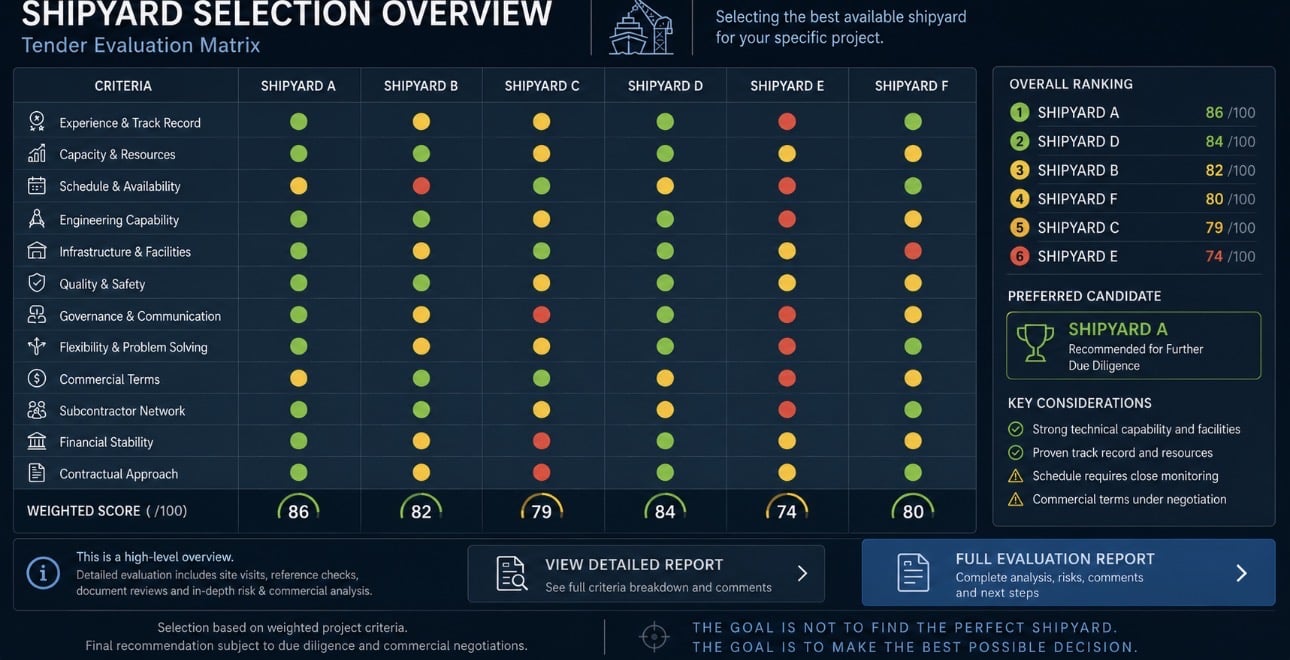
There Is No Such Thing as the Perfect Shipyard
Owners regularly ask which shipyard I would recommend for a particular refit or conversion. My answer is always the same: there is no such thing as the perfect shipyard. There is only the best available shipyard for a specific project.
Selecting a shipyard is one of the most important decisions an owner will make. It determines far more than where the vessel will physically be rebuilt. It influences project quality, schedule, communication, commercial risk and, ultimately, whether the owner’s objectives are achieved. A poor selection can result in delays, escalating costs and compromises that continue long after delivery. The right selection creates the foundation for a successful project.
The decision should therefore never be based on reputation, location or tender price alone. Every project has its own technical challenges, operational requirements, budget, regulatory framework and desired level of finish. The best shipyard is the one whose capabilities align with those specific requirements.
The Project Determines the Shipyard
Different projects require different expertise. A relatively recent yacht returning for a major refit may benefit from the knowledge of the original builder. Existing documentation, supplier relationships and familiarity with the vessel can significantly reduce uncertainty during the project.
The opposite can also be true. A commercial vessel being converted into an explorer yacht or liveaboard often benefits from a shipyard with extensive commercial shipbuilding or conversion experience. These yards are accustomed to heavy structural modifications, commercial machinery, regulatory compliance and practical engineering solutions. If the desired finish approaches superyacht standards, specialist subcontractors for paint systems, interiors, stainless steel fabrication or yacht electronics can be integrated where required. The objective is not to find a yard that does everything itself, but one capable of assembling the right expertise for the project.
Selecting a shipyard should therefore always begin with understanding the project itself. The vessel, the owner’s objectives and the required end result determine which capabilities matter most. The project should never be adapted to fit the shipyard.
Capability Before Reputation
Well known shipyards often have an excellent reputation, but reputation alone should never determine the outcome of a tender. Every shipyard has strengths developed through years of experience in particular market segments. Those strengths do not automatically transfer to every type of project.
A luxury yacht refit requires different working practices than a commercial vessel conversion. The required finish, protection of completed areas, logistics and daily working environment are often fundamentally different. Likewise, a commercial yard may outperform a luxury yard when extensive structural modifications or machinery replacements form the core of the project. Neither is inherently better. They simply solve different problems.
The question should therefore never be which shipyard is considered the best. The relevant question is which shipyard is best equipped to deliver this specific project.
Infrastructure Matters
The physical capabilities of a shipyard deserve the same attention as its engineering expertise. Dry docks, floating docks, ship lifts, slipways, travel lifts, covered construction halls, crane capacities and workshop facilities all influence how efficiently a project can be executed.
Geographical location also plays an important role. Climate, accessibility, transport connections, accommodation for owners and crew and the surrounding maritime industry can all affect project efficiency. Established maritime clusters often provide immediate access to specialist subcontractors, surveyors, coating specialists, system integrators and other expertise that may only occasionally be required but can become critical during complex refits.
Infrastructure should therefore be evaluated as part of the overall project strategy rather than considered as an isolated facility issue.
Looking Beyond the Tender Price
One of the most common mistakes during shipyard selection is assuming that the lowest tender represents the lowest project cost.
The cheapest tender is often not the cheapest tender.
A tender is only meaningful when the underlying scope of work, assumptions, exclusions, planning and contractual framework are fully understood. Two shipyards may submit similar prices while offering fundamentally different projects. Equally, two substantially different prices may become understandable once differences in scope, contingency allowances and commercial assumptions are examined.
Experienced shipyards often recognise technical uncertainties long before construction begins. Older vessels frequently reveal hidden defects, undocumented modifications or additional work once demolition starts. Some shipyards include realistic allowances for those uncertainties from the outset, while others price more aggressively and expect additional work to be agreed through change orders during the project. Neither approach is necessarily wrong, provided the assumptions are transparent and understood before the contract is signed.
For that reason, comparing tenders is rarely about comparing prices. It is about comparing the projects those prices actually represent.
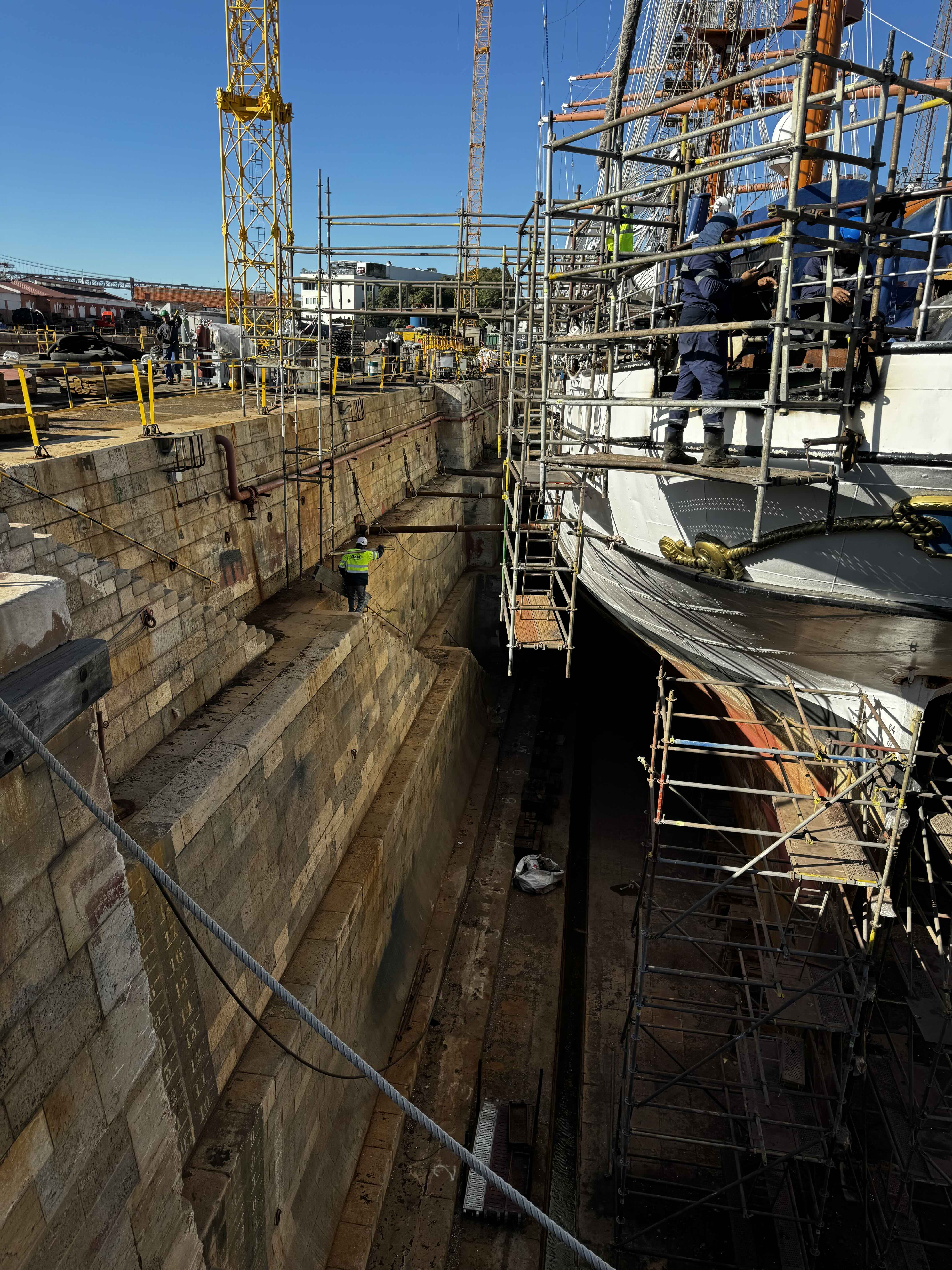
Walking the Yard
A tender provides valuable information, but it rarely tells the full story. Visiting a shipyard remains one of the most valuable parts of the selection process. A polished presentation explains how a shipyard wants to be perceived. Walking the yard shows how it actually operates.
The first visit often provides a surprisingly accurate impression. Not because every observation is immediately conclusive, but because patterns quickly become visible. How organised is the yard? How do employees interact with one another? How are vessels protected during ongoing work? Does safety appear to be part of the daily operation or simply part of the induction manual? These observations rarely determine the final decision on their own, but they contribute to the overall picture.
A tidy yard is not automatically a good yard, just as a busy or untidy yard is not automatically a poor one. The objective is not to judge appearances. The objective is to understand how the organisation functions in practice.
People Build Projects
Selecting a shipyard is ultimately about selecting people. Facilities, cranes and workshops are important, but projects are delivered by engineers, project managers, supervisors and craftsmen.
Particular attention should be paid to the assigned project manager. Technical knowledge is essential, but leadership, communication and decision-making often determine whether a project runs smoothly. A capable project manager coordinates disciplines, challenges assumptions, communicates openly and creates confidence within both the owner’s team and the shipyard itself.
The same applies to the management team. One misunderstanding rarely determines the outcome of a selection. However, when different members of management provide conflicting information or unrealistic expectations, it may indicate a wider organisational issue. Trust remains important, but consistency and transparency are far more valuable.
The Best Shipyards Ask Difficult Questions
Owners sometimes expect the preferred shipyard to immediately agree with every aspect of the project. In practice, the opposite is often true.
The best shipyards usually ask the most difficult questions before the contract is signed. They challenge assumptions, identify missing information and test whether the proposed scope of work is technically achievable within the available budget and schedule. Those discussions should not be viewed as obstacles. They demonstrate that the shipyard is actively evaluating the project rather than simply pricing it.
A shipyard that asks challenging questions during the tender phase often reduces the number of surprises during construction.
Expertise Is About Knowing Your Limits
Very few shipyards excel in every discipline. Some are recognised for structural work, others for coatings, yacht interiors, engineering, electrical integration or complex machinery installations.
The strongest shipyards are not necessarily those that perform everything in-house. They are the ones that understand where specialist expertise adds value and are prepared to involve the right subcontractors when required. Selecting experienced partners for paint systems, interior construction, stainless steel fabrication or specialist engineering should be viewed as a strength rather than a weakness, provided those subcontractors are properly coordinated and integrated into the project.
Projects succeed because the right expertise is applied at the right time, not because one organisation attempts to do everything itself.
The Contract Should Support the Project
Selecting a shipyard also means selecting a contractual relationship. Every shipyard has preferred contract structures, commercial conditions and ways of allocating risk. Whether the agreement is based on BIMCO, a customised contract or another recognised framework is less important than the willingness of both parties to discuss it openly.
A constructive relationship between the owner’s legal advisers and the shipyard often prevents disputes later in the project. Contracts should clearly define responsibilities, change management, payment milestones and risk allocation without creating unnecessary confrontation before construction has even begun. The objective is not to negotiate every clause endlessly. The objective is to establish a framework that supports cooperation when problems inevitably arise.
Tender Only When the Project Is Ready
A tender should never be used to discover what the project is. It should be used to compare how different shipyards propose to execute an already well-defined project.
Minor details such as paint colours or equipment preferences rarely justify postponing a tender. Fundamental uncertainties do. If the intended operational profile, classification strategy, major engineering solutions or overall project vision remain unresolved, the resulting tenders will inevitably be based on different assumptions. At that point, comparing prices becomes largely meaningless because the shipyards are no longer pricing the same project.
A complete scope of work remains one of the strongest foundations for a successful tender process.
Making the Best Possible Decision
The objective of a shipyard selection is not to find certainty. Complete certainty does not exist.
Every project involves assumptions, technical uncertainties and commercial risks. The role of due diligence, structured evaluation and independent governance is not to eliminate those uncertainties, but to ensure they are understood before commitments are made.
Ultimately, there is no such thing as the perfect shipyard. There is only the best available shipyard for a specific project, selected on the basis of technical capability, commercial understanding, transparency and the ability to deliver the owner’s objectives.
Good shipyard selection is therefore not about finding the perfect answer. It is about making the best possible decision with the information available at that moment.